ESG and carbon reduction: cut carbon in the building, not just on the report.
Credible reporting is essential, but it should illuminate physical improvements rather than substitute for them. BECORP delivers reduction work that is documented for reporting, financing, GBI and customer ESG requests.
What’s in scope
From reporting to real reduction.
ESG has moved beyond sustainability claims. Stakeholders increasingly expect evidence that environmental impact is being reduced, not only reported.
01
Baseline & Boundary
Energy use and emission sources are established before any reduction is claimed.
02
Demand Reduction
Heat gain through the roof, walls and glazing is cut first, so less cooling energy is needed.
03
Embodied & Operational Carbon
Material choice, such as recycled-fibre insulation, and operating energy are considered together.
04
Evidence for Reporting
Before and after readings and reduction figures arrive formatted for sustainability reports and customer ESG requests.
05
GBI & Incentive Support
Envelope performance data is prepared for green-building assessors, to help clients pursue applicable incentives, subject to eligibility.
06
Verified Outcomes
Outcomes are measured against an agreed baseline and method, where applicable.
Whole-life thinking
Decarbonisation starts at the brief, not after handover.
The earliest decisions shape both embodied and operational performance.
Upfront & Embodied
Materials and construction create impacts before a building is occupied.
In Use & Operational
Energy demand and the way a building is used shape its impacts throughout operation.
Scope 3
For many organisations Scope 3 can be materially larger than direct emissions, depending on sector and boundary.
Efficiency First
Avoidable demand is reduced first, and cleaner supply is then sized to the actual need.
How a project runs
From assessment to verification.
Performance is designed, installed and evidenced rather than assumed.
01
Assess
Assess building and energy performance, and the ESG evidence you need.
02
Audit
Engage the appropriate registered energy professional where required.
03
Identify
Locate avoidable demand: heat-gain paths, thermal bridges and envelope opportunities.
04
Design
Select systems, compliance evidence and a measurement plan.
05
Execute
Supply, install and project-manage with disciplined quality controls.
06
Verify
Measure and verify outcomes against an agreed baseline and method.
Scroll for more steps →
Malaysia regulation
What does EECA 2024 mean for your business?
The Energy Efficiency and Conservation Act 2024 has been in force since 1 January 2025 in Peninsular Malaysia and the Federal Territory of Labuan. Energy-consumer obligations apply at 21,600 GJ or more across 12 consecutive months.
This is an executive overview only. Confirm applicability, reporting scope and obligations with qualified advisers.
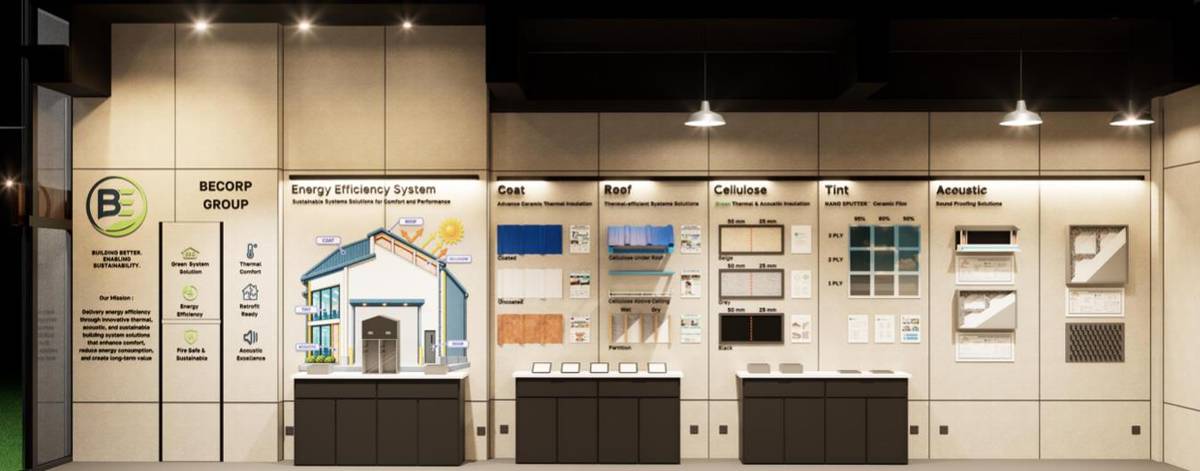
A real building fitted with BECORP insulation as a CSR initiative. Documented comparisons give a benchmark for the reduction in indoor temperature and the energy saved, and the site can be visited.